
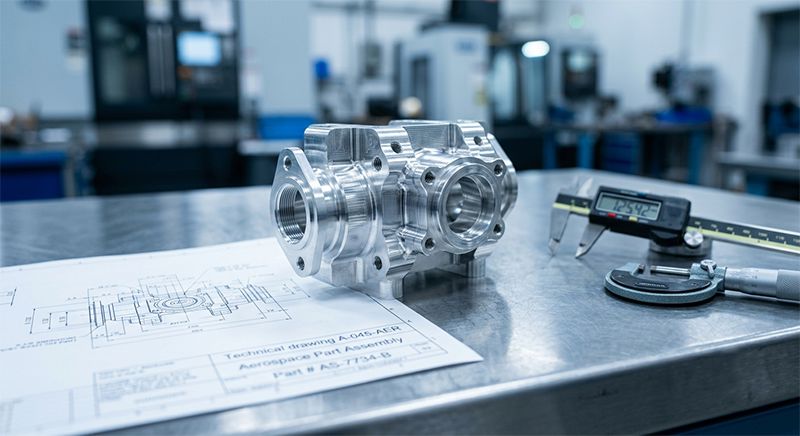
The single biggest sticker shock in aerospace machining isn’t the material or the machine time. It’s everything around them — the compliance documentation, the first-article inspection, the material certification, the ITAR overhead, the NRE for fixturing a part that’ll only run 25 pieces. Those costs don’t show up on a generic “CNC machining cost calculator,” and they’re the reason an aerospace bracket costs $380 when a dimensionally identical commercial bracket costs $85.
Quick Summary: Aerospace part cost is driven by five factors that barely exist in commercial machining: non-recurring engineering (NRE) for process planning and fixturing, compliance overhead (ITAR, AS9100D, CMMC), material certification and traceability, first-article inspection per AS9102, and tighter tolerance bands that demand slower feeds and more inspection. Material and machine time — the things most cost guides focus on — are often less than half the total.
Why Does the Same Geometry Cost 3–5x More for Aerospace?
Take a simple aluminum bracket. 6061-T6, three holes, a slot, a couple of bends. If a commercial customer sends that drawing to a general machine shop, it gets quoted as material plus machine time plus a small markup. Maybe $60–$100 depending on quantity.
Now put an ITAR flag on it, call out AS9100D quality requirements, add a material cert requirement to AMS-QQ-A-250/11, and request a first-article inspection report per AS9102. Same bracket. Same geometry. Same alloy. The quote triples, minimum.
Every one of those requirements adds documented labor to the job.
Where Does the Money Actually Go?
A rough cost allocation for a typical low-volume (10–50 piece) aerospace CNC part versus an identical commercial part:
| Cost Element | Commercial Part (% of total) |
Aerospace Part (% of total) |
|---|---|---|
| Raw material (with cert) | 15–25% | 10–15% |
| Machine time | 40–50% | 20–30% |
| Programming / NRE | 10–15% | 10–15% |
| Fixturing | 0–5% | 5–15% |
| Compliance documentation (ITAR, AS9100D, traveler) | 0% | 10–20% |
| First article inspection (AS9102) | 0% | 5–15% |
| QC / in-process inspection | 5–10% | 10–15% |
The two biggest shifts: machine time drops as a percentage (not because there’s less of it, but because everything else grows around it), and compliance documentation goes from zero to a meaningful chunk of the job cost.
What Is NRE and Why Does It Hit Aerospace Parts Harder?
Non-recurring engineering is the upfront work that happens before a chip is cut: process planning, programming, fixture design, first-piece prove-out, and documentation. On a commercial job, the programmer might spend 30 minutes setting up a simple 3-axis program and running it with a standard vise. On an aerospace job for the same geometry, the process plan needs to account for material traceability, in-process inspection points, documented tool lists, and sometimes a dedicated fixture if the part can’t be safely held in standard workholding without risking distortion.
That fixture might cost $500–$2,000 to build. It’s amortized across the order — so 200 parts barely feel it, but 10 parts absorb $50–$200 each just in fixturing.
For a deeper breakdown of how setup costs, material costs, and machine time contribute to small-batch pricing, eMachineShop’s cost breakdown guide covers the fundamentals.
How Much Does Compliance Documentation Actually Add?
More than most buyers expect.
ITAR (International Traffic in Arms Regulations): Requires that every person who touches the job — programmer, operator, inspector, shipping clerk — is a U.S. person. The shop needs an active ITAR registration (ours is M52808), and the administrative overhead of maintaining that registration, training staff, and managing access control adds to shop rate. It’s not a per-part charge, but it’s baked into the hourly rate at every ITAR-registered facility.
AS9100D: The aerospace quality management system standard adds roughly 105 clauses on top of ISO 9001:2015. In practice, that means more documentation per job — traveler packets, in-process inspection records, nonconformance tracking, and calibration records for every measuring instrument used. A shop running AS9100D carries more quality overhead per job than an ISO-only shop, and that cost is real.
CMMC (Cybersecurity Maturity Model Certification): Increasingly required for defense work. Maintaining a CMMC-compliant IT environment (encrypted file storage, access controls, incident response plans) costs money that gets distributed across the shop rate. The certification itself isn’t cheap either.
None of these are optional if the drawing says they’re required. And none of them are free.
What Does Material Certification Add?
Commercial machining: you order 6061-T6 from your distributor, it shows up with a mill cert, you throw the cert in a file and start cutting.
Aerospace machining: you order 6061-T6 to AMS-QQ-A-250/11, the mill cert has to trace back to the specific heat lot, the cert has to match the drawing callout exactly (not “equivalent” — exact), and you file that cert in a job-specific traveler that follows the part through every operation. If the cert doesn’t match or is missing, the material can’t be used. Period.
Some aerospace programs also require dual certification (two independent tests confirming material properties), which limits which distributors can supply the material and can add 10–20% to raw material cost.
What Does First Article Inspection (FAI) Actually Cost?
First article inspection per AS9102 is a full dimensional verification of every feature on the drawing — every dimension, every tolerance, every GD&T callout — documented in a formal report with actual measured values. On a simple bracket with 30 dimensions, that might take 1–2 hours on a CMM plus documentation time. On a complex machined housing with 150+ dimensions and GD&T, it can take a full day.
FAI cost is typically absorbed into the first production run. On a 500-piece order, it’s negligible per part. On a 10-piece order, it can add $50–$150 per part.
The buyer doesn’t always realize they’re paying for FAI until they compare an aerospace quote against a commercial quote for the same geometry and wonder why there’s a $1,500 line item that doesn’t appear on the other quote.
How Do Tighter Tolerances Affect Cost?
General commercial machining holds ±0.005” (±0.127mm) as standard without much fuss. Aerospace drawings routinely call ±0.001” (±0.025mm) or tighter on critical features, with GD&T position callouts, profile tolerances, and true position requirements that demand slower cutting speeds, more in-process inspection, and sometimes temperature-controlled environments.
Each step tighter roughly doubles the time per feature — not because the machine can’t get there, but because proving it got there takes longer than cutting it did.
Frequently Asked Questions
Why can’t I just get my aerospace part made at a commercial shop for less? You can get it machined at a commercial shop. You can’t get it certified, documented, and traceable at a commercial shop. If the end use requires ITAR, AS9100D, or material traceability, the shop has to carry those certifications and systems — and that costs money regardless of part complexity.
Is there a minimum order where aerospace machining costs start to make sense? The compliance and documentation overhead is mostly fixed per job, not per part. So yes — higher quantities spread those costs thinner. But “higher” in aerospace is often 25–100 pieces, not 10,000.
Can I reduce aerospace part cost without dropping compliance requirements? Yes — through DFM review. Relaxing non-critical tolerances, consolidating features to reduce setups, and standardizing material callouts to commonly stocked aerospace grades all reduce cost without touching the compliance wrapper. For design-for-manufacturability guidance on reducing part cost, eMachineShop’s cost-reduction tips page is a practical starting point, and the principles translate directly to aerospace work.
Reach out to discuss how compliance requirements affect quoting for your specific program.
Written by James Wright, CEO of Accurate Machine & Tool.
Sources
[1] eMachineShop, “Breakdown of Custom Manufacturing Costs,” emachineshop.com/breakdown-of-custom-manufacturing-costs
[2] SAE International, AS9102 — Aerospace First Article Inspection Requirement
[3] AS9100D — Quality Management Systems, Requirements for Aviation, Space, and Defense Organizations