
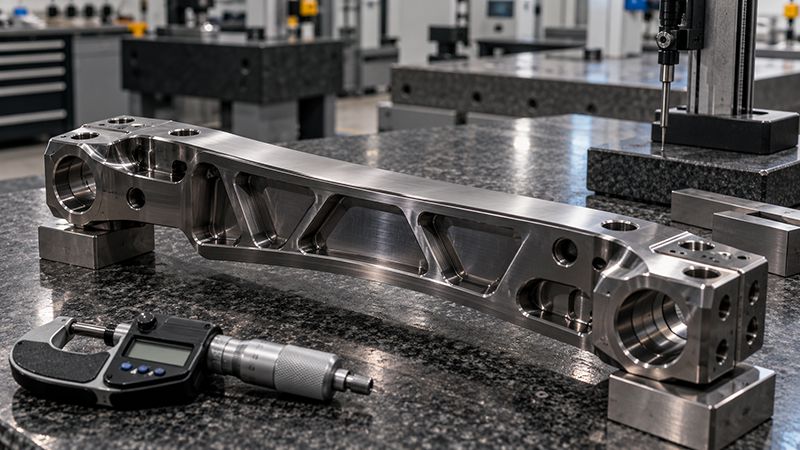
Heat treatment changes dimensions. Not by a lot — but enough to push a tight-tolerance feature out of spec if nobody planned for it. The part goes into the oven at ±0.0005” and comes out at ±0.002” because it grew, shrank, warped, or all three. The heat treater met their spec. The machinist met theirs. The part still doesn’t fit.
Quick Summary: Dimensional change from heat treatment depends on the process (stress relief, age hardening, case hardening, quench-and-temper), the alloy, the part geometry, and how the part was supported in the oven. Typical growth on steel parts from through-hardening runs 0.0005”–0.002” per inch. Case hardening (carburizing, nitriding) adds material to the surface and can grow ODs by 0.001”–0.005” depending on case depth. The fix: machine features that need tight tolerance after heat treatment, not before, or leave stock on critical features and finish-grind after hardening.
How Much Do Parts Actually Move?
| Heat Treatment Process | Typical Dimensional Change | Direction |
|---|---|---|
| Stress relief (steel, 1000–1200°F) | 0.0001”–0.0005”/inch | Slight shrinkage or relaxation of machining stress |
| Age hardening (aluminum, 17-4PH) | 0.0002”–0.001”/inch | Growth — precipitation causes lattice expansion |
| Through-hardening (4140, 4340 quench+temper) | 0.0005”–0.002”/inch | Growth from austenite-to-martensite transformation |
| Carburizing (case hardening) | 0.001”–0.005” on case-hardened surfaces | Growth — carbon diffusion adds material at the surface |
| Nitriding | 0.0002”–0.001” on nitrided surfaces | Slight growth — nitrogen diffusion |
| Solution treatment + age (Inconel, Ti-6Al-4V) | 0.0003”–0.001”/inch | Variable — depends on prior condition |
These are ranges, not guarantees. Actual movement depends on geometry (thin walls move more than thick ones), oven loading (parts touching each other or resting on unsupported spans), and heating/cooling rates.
Why Does This Catch People Off Guard?
Because the machinist and the heat treater each do their job correctly, and the part still fails inspection afterward. The drawing says “machine to ±0.0005”, heat treat per AMS 2759.” Both vendors hit their targets. But the drawing didn’t specify which dimensions are before heat treatment and which are after — so the machinist cut to final, the heat treater shifted the dimensions by 0.001”, and the finished part is out of tolerance.
eMachineShop’s overview of the aluminum anodizing process covers a similar issue — coating buildup changing dimensions after machining. Heat treatment has the same fundamental problem: a post-machining process that moves the dimensions, requiring the machinist to either pre-compensate or leave stock for a post-heat-treatment finishing pass.
What’s the Right Machining Sequence?
For through-hardened parts (4140, 4340, tool steels): Rough machine → heat treat (quench + temper) → finish-grind or hard-turn to final dimensions. Grinding after hardening is standard practice for bores, ODs, and sealing surfaces. Most hardened-steel aerospace parts follow this sequence.
For case-hardened parts (carburized or nitrided): Machine to near-final → mask surfaces that shouldn’t be hardened → carburize or nitride → finish-grind hardened surfaces. The case adds material, so critical dimensions must be ground after case hardening.
For age-hardened aluminum or precipitation-hardened stainless (17-4PH): Machine to final before aging if dimensional change is within tolerance. If not, rough machine → age → finish-machine. Age hardening produces smaller dimensional changes than quench-hardening, so many aluminum parts are machined to final before aging without issues.
Frequently Asked Questions
Can the heat treater guarantee dimensional stability? They can control their process (temperature, time, quench rate, fixturing), but they can’t control the geometry of the part or the stress state from prior machining. Distortion is a combined result of all three.
Should the drawing specify “dimensions before/after heat treatment”? Yes. This is the single most effective way to prevent the machinist-vs-heat-treater ambiguity. If the drawing is silent, the machinist typically assumes dimensions are before heat treatment.
Is cryogenic treatment an alternative to manage dimensional change? Cryogenic treatment (deep freezing after quench) stabilizes retained austenite in tool steels, reducing subsequent dimensional instability. It doesn’t eliminate heat-treatment growth — it reduces post-treatment creep over time. Useful for gauge blocks, precision tooling, and long-life aerospace components.
Written by James Wright, CEO of Accurate Machine & Tool.
Sources
[1] eMachineShop, “Unlocking the Secrets of Aluminum Anodizing,” emachineshop.com
[2] ASM International — heat treatment dimensional change data, asminternational.org
[3] AMS 2759 — Heat Treatment of Steel Parts, General Requirements