
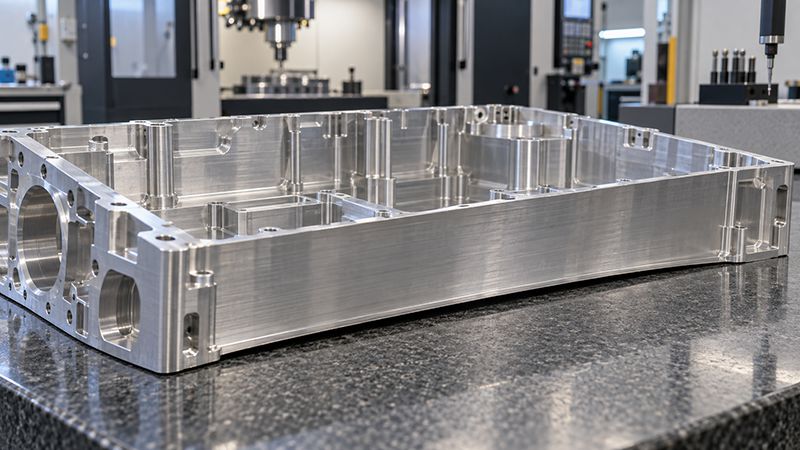
When you remove material from a billet, the stress that was locked in the raw stock redistributes. On a simple commercial bracket, nobody notices. On a thin-wall aerospace housing machined from a forging, the part can bow, twist, or spring open the moment it comes off the fixture. The geometry was perfect on the machine. It’s out of spec on the inspection table.
Quick Summary: Residual stress from machining comes from two sources: stress inherited from the raw material (forging, casting, rolling) released when material is removed, and new stress introduced by the cutting process itself (heat and deformation at the tool/workpiece interface). Both affect dimensional stability and fatigue life. Mitigation strategies include stress-relief heat treatment between roughing and finishing, climb milling to reduce surface stress, and designing machining sequences that remove material symmetrically.
Where Does Residual Stress Come From?
Inherited stress. Forgings, castings, and rolled plate all carry internal stress from their forming process. When you machine away material, you’re removing the material that was balancing that stress. The remaining material shifts to find a new equilibrium — and that shift shows up as distortion.
Thick-to-thin machining is the worst case. A 2”-thick forging machined down to 0.100” walls is removing 95% of the stress-balancing material. The thin walls that remain have almost no stiffness to resist the residual stress still locked in. The part moves.
Cutting-induced stress. The tool itself introduces stress in a thin layer at the machined surface. Aggressive cuts with dull tools generate heat, which creates tensile residual stress at the surface — bad for fatigue life. Light finish cuts with sharp tools, or climb milling instead of conventional milling, reduce this effect.
eMachineShop’s guide on material machinability covers how different materials respond to cutting forces. For aerospace, the dimensional stability question is what makes residual stress a design and process planning issue, not just a machining parameter.
How Do You Control It?
Rough, relieve, finish. The most reliable approach for distortion-prone parts: rough-machine to within 0.030”–0.060” of final dimensions, stress-relieve (thermal cycle per AMS 2759 or alloy-specific spec), then finish-machine to final. The stress relief between passes lets the part move before the final dimensions are cut.
Symmetric material removal. Machine both sides of a plate or forging before finishing either side. If you finish one face first, the released stress from the opposite side’s roughing pass can pull the finished face out of tolerance.
Fixture clamping strategy. Over-clamping a part that wants to move just masks the distortion until you release it. Light, distributed clamping or vacuum fixturing lets the part settle into its natural state during machining.
Frequently Asked Questions
How do I know if my part is at risk for distortion from residual stress? High material-removal ratios (removing more than 50% of the starting stock), thin walls relative to overall dimensions, and asymmetric machining (heavy cuts on one side, light on the other) are the primary risk factors.
Does stress relief add a lot of cost? It adds a heat treatment cycle (typically $200–$800 per batch depending on oven size and alloy) plus the time to re-fixture and re-indicate the part for the finish pass. On parts where distortion would cause rejects, it’s far cheaper than scrapping finished parts.
Can simulation predict residual stress distortion? Increasingly, yes. FEA-based machining simulation can estimate distortion from material removal, but it requires accurate knowledge of the incoming material’s stress state — which is often unknown for forgings and castings. Simulation is a planning tool, not a guarantee.
Written by James Wright, CEO of Accurate Machine & Tool.
Sources
[1] eMachineShop, “Understanding the Impact of Material Machinability,” emachineshop.com
[2] The Fabricator — residual stress in machined components, thefabricator.com
[3] Machinery’s Handbook, 32nd Edition — stress relief and heat treatment (Industrial Press)