
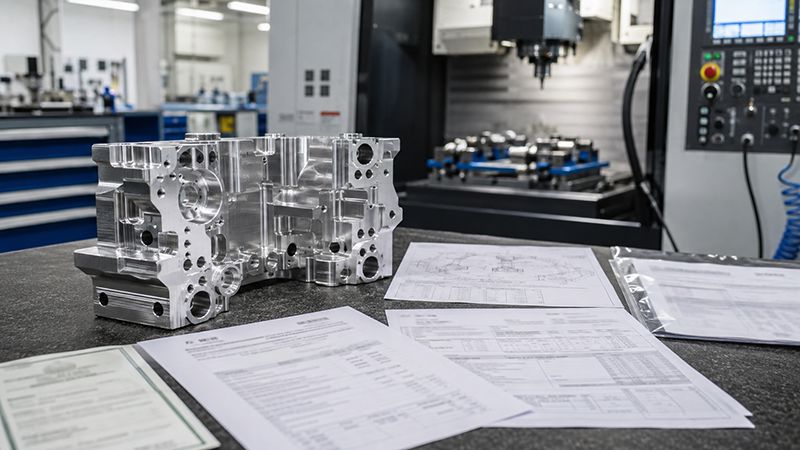
Most CNC quotes arrive as a single number per part — unit price times quantity, done. That works fine for simple commercial jobs. Aerospace quotes are different. They may break the cost into line items because different parts of the cost behave differently: some are per-piece, some are per-order, and some only happen once and never again.
Quick Summary: A well-structured aerospace CNC quote separates Non-Recurring Engineering (NRE which include programming, fixture, first-article inspection) from recurring piece price (material, machine time, finishing, QC per part). Understanding what’s in each bucket lets you negotiate intelligently, forecast repeat-order costs accurately, and compare quotes from different shops on an apples-to-apples basis.
What Are the Typical Line Items on an Aerospace CNC Quote?
| Line Item | One-Time or Per-Piece | What It Covers |
|---|---|---|
| Programming / NRE | One-time | CAM programming, process planning, documentation setup |
| Fixture / tooling | One-time | Custom workholding if standard vise won’t work |
| First article inspection | One-time (per part number) | Full dimensional report per AS9102 |
| Material | Per-piece | Raw stock plus material cert to the called-out spec |
| Machine time | Per-piece | Actual cutting, plus load/unload and in-process inspection |
| Secondary operations | Per-piece | Deburring, tapping, pressing inserts, marking |
| Outside processing | Per-piece | Heat treatment, anodizing, plating, NDT at subcontracted vendors |
| Final QC / packaging | Per-piece | Dimensional verification, paperwork, packaging to spec |
Why Do Shops Quote Differently From Each Other?
Because they bundle line items differently. Shop A might roll programming, fixturing, and FAI into the piece price — so the unit cost is higher but there’s no NRE line. Shop B might break them out as separate charges — lower unit price, but $3,000 in one-time costs on top.
On a 500-piece order, the difference barely matters. On a 10-piece order, it changes the comparison entirely. Always ask: is the NRE included in the piece price or separate? If the quote doesn’t say, ask before comparing.
eMachineShop’s breakdown of custom manufacturing costs covers how setup and material costs contribute to the total — the framework applies directly, with aerospace adding the compliance and documentation layers on top.
What Should You Look For When Comparing Quotes?
Total cost at your actual quantity. Don’t compare unit prices alone. Compare (unit price × quantity) + NRE for each quote. The shop with the lower unit price may have higher NRE that makes them more expensive at your volume.
What’s included in “outside processing.” Heat treatment, anodizing, plating — these are often subcontracted. Some shops mark them up 15–30%. Others pass them through at cost. Ask.
Repeat-order pricing. Once the NRE is paid, the repeat order should drop by the amount of the one-time charges. If a shop quotes the same price on a repeat order with no process changes, they either built NRE into the piece price (fine) or they’re double-charging (not fine).
Lead time tied to the quote. A quote with a 4-week lead time and a quote with an 8-week lead time aren’t comparable even at the same price. Ask whether the lead time includes outside processing turnaround.
Frequently Asked Questions
Should I push back on NRE charges? Pushing back on the amount is reasonable — programming time varies by shop efficiency. Pushing back on the concept is counterproductive. NRE reflects real labor that happens before your parts are cut. Shops that don’t charge NRE have buried it in the piece price.
Why is material cost higher on aerospace quotes? Because the material has to come with a traceable mill cert to the specific AMS or ASTM spec on the drawing. Certified aerospace-grade material from an approved distributor costs more than generic commercial-grade from a metals warehouse, even if the alloy is identical.
Can I supply my own material to save money? Some shops accept customer-furnished material (CFM). Most prefer to source their own for traceability reasons — if they bought it, they control the cert chain. If you supply it, they have to verify your cert, which adds its own cost.
Written by James Wright, CEO of Accurate Machine & Tool.
Sources
[1] eMachineShop, “Breakdown of Custom Manufacturing Costs,” emachineshop.com
[2] Modern Machine Shop — quoting and job costing best practices, mmsonline.com
[3] AS9100D — Quality Management Systems for Aviation, Space, and Defense