
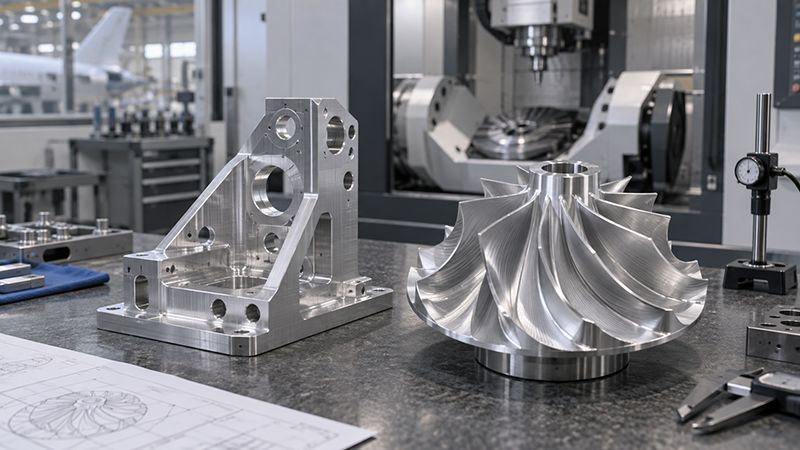
The sales pitch for 5-axis is that it does everything in one setup. That’s true. What the sales pitch doesn’t mention is that 5-axis programming takes longer, the machine costs more per hour, and a lot of parts that get quoted on 5-axis would be cheaper on a 3-axis machine with a couple of repositions.
Quick Summary: Full simultaneous 5-axis machining saves money on parts with complex contoured surfaces (turbine blades, impellers, aerospace fairings) where the tool must continuously change its angle relative to the workpiece. For parts with features on multiple faces but no complex contouring — brackets, housings, manifolds — 3+2 machining (locking the rotary axes at fixed angles and cutting with 3-axis motion) is usually cheaper because programming is simpler and the machine can be less expensive. The break-even depends on part geometry, batch size, and how many setups the 3+2 approach eliminates.
What’s the Actual Difference?
| 3+2 (Positional 5-Axis) | Simultaneous 5-Axis | |
|---|---|---|
| Rotary axes | Lock at fixed angles between cuts | Move continuously during cuts |
| Programming complexity | Moderate — essentially 3-axis programs at different orientations | High — requires advanced CAM and post-processing |
| Machine requirement | Any 5-axis or 4+1 machine | True simultaneous 5-axis with tight rotary axis calibration |
| Typical hourly rate | $75–$125/hr | $100–$200/hr |
| Best for | Multi-face prismatic parts (brackets, housings) | Complex contoured surfaces (blades, impellers, organic shapes) |
| Setup reduction | Yes — access 5 faces in one setup vs. 2–3 setups on 3-axis | Yes — same advantage plus continuous surface machining |
When Does Simultaneous 5-Axis Actually Pay for Itself?
Complex contoured surfaces. A turbine blade with a compound-curved airfoil surface can’t be cut with fixed-angle positioning. The tool needs to continuously adjust its orientation to maintain proper engagement with the surface. This is where simultaneous 5-axis is the only option, not a luxury.
Deep cavities with draft angles. A mold cavity or deep pocket where a shorter, more rigid tool at an angled approach can reach the bottom without the chatter and deflection that a long-reach tool would produce on a 3-axis machine. The 5-axis approach trades programming complexity for better surface finish and faster cycle time on the cut itself.
Parts where setup time dominates. If a part requires 5 setups on a 3-axis machine (one per face), and each setup takes 20 minutes of alignment and indication, that’s nearly 2 hours of non-cutting time on a 10-piece batch. A 5-axis machine eliminates 4 of those setups. At $100/hr, that’s $160 saved — which may or may not offset the higher hourly rate and programming cost. On a 100-piece batch, it almost certainly does.
When Is 3+2 the Smarter Choice?
Most prismatic aerospace parts — brackets, mounting plates, manifolds, adapter blocks — have features on multiple faces but no complex contouring. A 3+2 approach machines each face at a fixed rotary angle using standard 3-axis toolpaths. The programming is faster, the cycle time is comparable, and the machine rate is lower.
eMachineShop’s overview of CNC machining methods covers the general process categories. For aerospace specifically, the decision usually comes down to whether the geometry requires continuous tool-angle changes (→ simultaneous 5-axis) or just access to multiple faces (→ 3+2).
Frequently Asked Questions
Does 5-axis always produce better surface finish? Not inherently. Surface finish depends on tool engagement, feeds and speeds, and machine rigidity. A well-programmed 3-axis cut can match or beat a poorly programmed 5-axis cut. The 5-axis advantage is access and tool orientation, not automatic finish improvement.
Can I request 3+2 instead of simultaneous 5-axis to save money? Yes — if the geometry allows it. Tell the shop you’re open to 3+2 and let them evaluate. Most shops will default to the most efficient approach anyway, but explicitly flagging cost sensitivity helps.
Is 5-axis accuracy better than 3-axis? In theory, fewer setups means fewer re-registration errors, which should improve positional accuracy between features on different faces. In practice, the rotary axes on a 5-axis machine introduce their own error sources (backlash, thermal drift). A well-maintained 3-axis machine with careful fixturing can match a 5-axis for positional accuracy on most prismatic parts.
Written by James Wright, CEO of Accurate Machine & Tool.
Sources
[1] eMachineShop, “Custom CNC Machining — Methods and Materials,” emachineshop.com
[2] Modern Machine Shop — 5-axis machining applications and cost analysis, mmsonline.com
[3] Machinery’s Handbook, 32nd Edition (Industrial Press) — machining process selection