
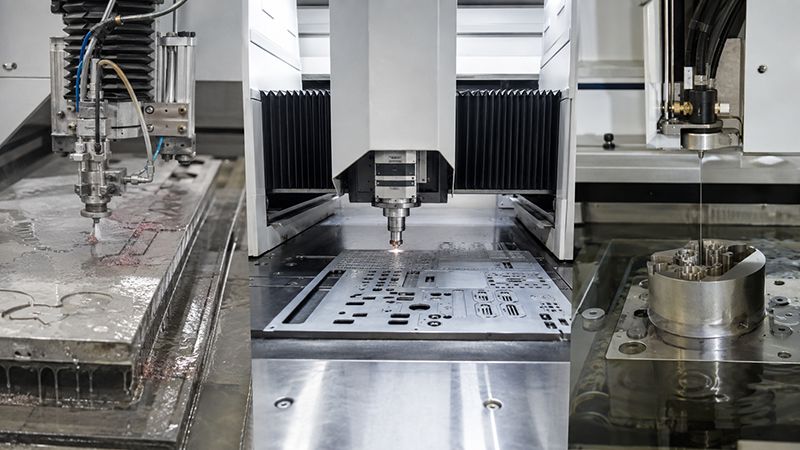
The right cutting process for an aerospace part depends on three things: the alloy, the thickness, and whether the cut surface is functional or just separating material. EDM belongs in the same conversation because it handles materials and geometries that neither waterjet nor laser can touch, and it shows up on aerospace drawings constantly.
Quick Summary: Laser wins on speed and cost for thin sheet (under 0.5”) in steel, aluminum, and titanium. Waterjet wins on thick material (0.5”–6”+), heat-sensitive alloys, and mixed-material stacks. Wire EDM wins on hardened materials, tight-tolerance internal profiles, and features where thermal distortion is unacceptable. Most aerospace jobs don’t pick one process — they use two or three on the same part, each for the features it handles best.
When Does Laser Cutting Win?
Laser cutting (fiber laser, specifically — CO2 is fading for metals) is the fastest and cheapest option for thin sheet metal in common aerospace alloys. For 6061 or 7075 aluminum under 0.25”, mild or stainless steel under 0.5”, and titanium under 0.125”, fiber laser is hard to beat on cycle time and edge quality.
The limits show up quickly in aerospace work:
Thickness ceiling. Fiber lasers cut aluminum up to about 1” and steel up to about 1.5”, but edge quality degrades above half those numbers. Aerospace drawings that call out surface finish on cut edges (common on structural members) may reject laser-cut edges on thicker stock.
Heat-affected zone (HAZ). The laser melts a narrow kerf, but the surrounding material sees enough heat to alter its microstructure. On non-heat-treated alloys, this rarely matters. On 7075-T6 or 2024-T3, the HAZ can reduce hardness and strength near the cut edge — a concern on fatigue-critical structures.
Reflective materials. Copper and brass reflect laser energy and can damage the optics on older machines. Newer fiber lasers handle this better, but shops still prefer waterjet for copper alloys.
eMachineShop’s comparison of waterjet vs laser cutting covers the general tradeoffs well. For aerospace alloys specifically, the HAZ question is usually what pushes the decision toward waterjet or EDM.
When Does Waterjet Cutting Win?
Waterjet cuts with a high-pressure stream of water and garnet abrasive. No heat. That single fact makes it the default choice for two common aerospace scenarios:
Thick stock. Waterjet cuts aluminum and titanium up to 6” or more without meaningful edge degradation. If the part is a 2”-thick titanium plate, waterjet is the only practical option outside of band-sawing and machining from solid (which wastes far more material).
Heat-sensitive applications. Because there’s no thermal input, there’s no HAZ, no microstructure change, and no residual stress from cutting. On alloys where material properties are tightly controlled (precipitation-hardened aluminum, solution-treated titanium), waterjet preserves the heat treatment that was there before cutting.
The tradeoffs:
Surface finish. Waterjet edges are rougher than laser edges, especially on the exit side where the jet deflects. Typical Ra is 125–250 μin (3–6 μm) on the entry side, worse on exit. If the cut edge is a mating surface, it usually needs a secondary machining pass.
Kerf width. Waterjet kerf runs 0.030”–0.050”, wider than laser (0.005”–0.015”). On small parts with tight nesting, the material waste is higher.
Speed. Waterjet is slower than laser on thin material — often 3–5x slower on 0.060” aluminum sheet. The cost per inch of cut is higher on thin stock.
When Does Wire EDM Belong in the Conversation?
Wire EDM rarely shows up in generic “cutting process comparison” guides, but it appears on aerospace drawings constantly. It uses a thin electrically charged wire to erode material — no mechanical cutting force, minimal thermal distortion, and the ability to hold tolerances that neither laser nor waterjet can approach.
Hardened materials. EDM doesn’t care about material hardness. It cuts D2 tool steel at 60 HRC the same way it cuts 6061-T6. For aerospace parts that are heat-treated before final profiling (hardened steel bushings, wear plates, hard-chrome-plated components), EDM is often the only option that doesn’t compromise the hardness.
Tight-tolerance internal profiles. Wire EDM holds ±0.0001”–0.0005” on cut features — a full order of magnitude tighter than waterjet and two orders tighter than most laser work. For internal keyways, spline profiles, and precision slots where the cut surface IS the functional feature, EDM is the process.
No cutting force. Because the wire never contacts the workpiece mechanically, there’s no clamping force or tool pressure. Thin-wall parts and delicate features that would deflect under a milling cutter or deform under waterjet pressure can be EDM’d without distortion.
The tradeoffs are real:
Speed. Wire EDM is slow. A keyway profile that laser cuts in 8 seconds might take 45 minutes on EDM. A complex internal spline on a hardened steel bushing — a common aerospace callout — can run 2–3 hours per part. It’s a precision process. Calling it a “cutting” process almost undersells how different the time math is.
Cost. EDM time runs $75–$150/hr, and the process is inherently slow, so cost per feature is high. It’s justified where no other process can hit the tolerance or get into the geometry. We typically see EDM called out on 5–15% of the features on a complex aerospace part, not on the whole profile.
Surface integrity. EDM leaves a recast layer — a thin zone of re-solidified material on the cut surface, typically 0.0002”–0.001” deep. On fatigue-critical parts, that recast layer can initiate cracks under cyclic loading. Many aerospace specs (and most primes’ internal standards) require the recast to be removed by a light grinding or polishing pass after EDM. That secondary step adds cost but isn’t optional on structural components.
Process Comparison at a Glance
| Fiber Laser | Waterjet | Wire EDM | |
|---|---|---|---|
| Speed | Fastest on thin stock | 3–5x slower than laser on thin; comparable on thick | Slowest — minutes to hours per profile |
| Typical tolerance | ±0.005”–0.010” | ±0.003”–0.005” | ±0.0001”–0.0005” |
| Kerf width | 0.005”–0.015” | 0.030”–0.050” | 0.004”–0.012” (wire diameter) |
| Heat-affected zone | Yes — matters on heat-treated alloys | None | Minimal (recast layer 0.0002”–0.001”) |
| Max practical thickness | ~1” aluminum, ~1.5” steel | 6”+ in most metals | Limited by wire travel, typically 12”+ |
| Surface finish (cut edge) | Ra 60–125 μin | Ra 125–250 μin | Ra 8–32 μin |
| Hourly rate | $50–$100/hr | $75–$125/hr | $75–$150/hr |
| Best aerospace fit | Thin sheet blanking, high volume | Thick plate, heat-sensitive alloys | Tight-tolerance internal profiles, hardened materials |
How Do You Decide for a Specific Part?
In practice, most aerospace parts don’t use one cutting process exclusively. A titanium bracket might get waterjet-cut from plate (no HAZ on the raw blank), then CNC-machined on mating surfaces, with wire EDM on one internal slot that needs ±0.0003” and can’t be reached by a cutter. Three processes, one part.
The decision framework:
Is the cut surface functional (mating, sealing, load-bearing)? If yes, the process has to deliver the surface finish and tolerance the feature requires. That usually means EDM for tight internal profiles, machining for mating faces, and waterjet or laser just for blank separation.
Is the alloy heat-sensitive or hardened? If yes, waterjet (no heat) or EDM (minimal heat, localized). Laser is risky.
Is the material thicker than 0.5”? If yes, waterjet or EDM. Laser edge quality degrades.
Is cost the primary driver? If yes and tolerance/HAZ aren’t critical, laser is cheapest on thin stock, waterjet on thick stock.
Frequently Asked Questions
Can laser cut titanium for aerospace use? Yes, but with limits. Fiber lasers cut titanium sheet up to about 0.125” with good edge quality. Above that, edge roughness and HAZ concerns push most aerospace work to waterjet. Titanium is also reactive at high temperature — laser cutting should be done with inert gas assist (argon or nitrogen) to prevent oxidation of the cut edge.
Does wire EDM leave witness marks that need to be removed? On most aerospace parts, yes. The recast layer (typically 0.0002”–0.001” deep) is often called out for removal on fatigue-critical surfaces. A light grinding or polishing pass takes care of it but adds cost and cycle time.
Which process has the least material waste? Laser, due to the narrowest kerf. Wire EDM is close (wire diameter is 0.004”–0.012”). Waterjet has the widest kerf and highest waste per cut inch.
Written by James Wright, CEO of Accurate Machine & Tool.
Sources
[1] eMachineShop, “The Pros and Cons of Waterjet vs Laser Cutting,” emachineshop.com/the-pros-and-cons-of-waterjet-vs-laser-cutting
[2] Machinery’s Handbook, 32nd Edition — cutting process selection tables (Industrial Press)
[3] American Machinist — EDM process fundamentals and aerospace applications, americanmachinist.com