
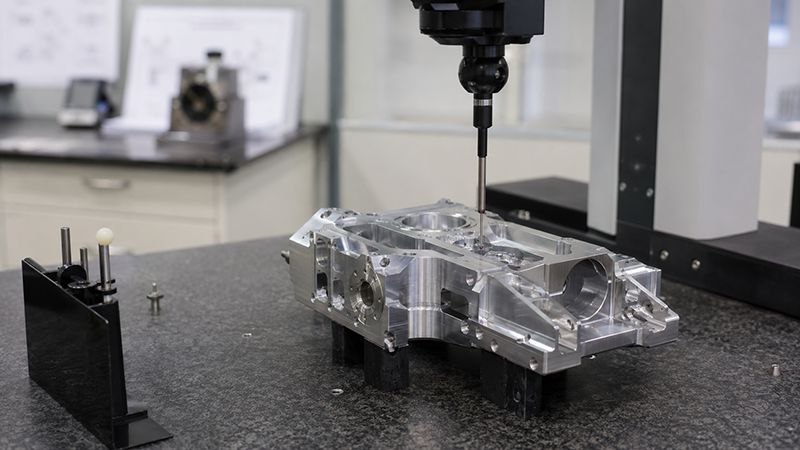
First article inspection is the reason your first aerospace production run costs more than every run after it. FAI per AS9102 is a complete dimensional verification of every single feature on the drawing — not a sampling plan, not a spot-check. Every dimension, every tolerance, every GD&T callout, measured and documented with actual values. If the drawing has 150 dimensions, that’s 150 measurements in the report.
Quick Summary: FAI is required on the first production part (or first part after a process change) for most aerospace and defense programs. It verifies that the manufacturing process produces parts that conform to the engineering drawing. The report follows AS9102 format — three forms covering part accountability, product characteristics, and raw material/special process data. Cost impact: 2–8 hours of CMM and documentation time per part, depending on complexity, absorbed into the first production run.
What Does an FAI Report Actually Contain?
AS9102 specifies three forms:
| Form | What It Covers | What the Shop Does |
|---|---|---|
| Form 1 — Part Number Accountability | Part number, revision, drawing number, PO reference, material, special processes | Administrative — fill in the header data, link to the traveler |
| Form 2 — Product Accountability (Characteristics) | Every dimension on the drawing, with nominal value, tolerance, and actual measured value | This is where the time goes — CMM measurement of every feature |
| Form 3 — Raw Material, Special Process, Functional Testing | Mill cert traceability, heat treatment records, plating/coating certs, NDT results | Collect and compile certs from material suppliers and process vendors |
Form 2 is the expensive one. A simple bracket with 30 dimensions might take an hour on the CMM plus 30 minutes of documentation. A complex housing with 200+ dimensions and GD&T can take a full day.
When Is FAI Required?
FAI is triggered by specific events, not by every order:
- First production run of a new part number — always required.
- After a process change — new machine, new fixture, new programming, new material source. If you moved the job from a 3-axis mill to a 5-axis, that’s a new FAI.
- After a design change — new revision with dimensional changes requires a partial or full FAI depending on what changed.
- After a long gap in production — some primes require re-FAI if the part hasn’t been produced for 12–24 months.
Not required on every repeat order if nothing changed. This is why the first run costs more and subsequent runs cost less — the FAI cost is front-loaded.
Why Does FAI Add So Much Cost on Small Orders?
The FAI cost is essentially fixed per part number, not per piece. Whether you’re making 10 parts or 500, the first article takes the same number of measurements. On a 500-piece order, that 4-hour CMM session adds maybe $2–$4 per part. On a 10-piece order, it adds $40–$80 per part.
This is one of the biggest cost drivers that buyers notice when comparing aerospace quotes to commercial quotes. The commercial quote doesn’t have FAI at all. The aerospace quote has a line item that can run $500–$3,000 depending on part complexity. eMachineShop’s breakdown of custom manufacturing costs covers how setup and inspection costs hit small batches harder — the same math applies here, amplified by aerospace documentation requirements.
Can FAI Be Skipped or Simplified?
Not if the contract or PO requires it. AS9102 compliance isn’t optional on programs that call it out.
Some customers accept a partial FAI (also called a delta FAI) when only certain dimensions changed on a revision — you re-measure the affected features and reference the previous FAI for everything else. This saves time but requires the previous FAI to still be valid.
Some programs accept digital FAI where the CMM output feeds directly into the report template, reducing documentation time. But the measurement time doesn’t change.
Frequently Asked Questions
Who pays for FAI — the shop or the customer? The customer, either as a line item or built into the piece price. Most shops break it out as a separate NRE charge on the first order.
Does FAI guarantee every subsequent part is good? No. FAI proves the process can produce conforming parts. Ongoing conformance depends on in-process inspection, SPC, and the shop’s quality system. FAI is a process validation, not a substitute for production QC.
What happens if the first article fails? The shop corrects the issue (tooling adjustment, re-programming, fixture modification), makes a new first article, and re-inspects. This re-work adds cost and time. Getting FAI right the first time is why process planning matters.
Written by James Wright, CEO of Accurate Machine & Tool.
Sources
[1] eMachineShop, “Breakdown of Custom Manufacturing Costs,” emachineshop.com
[2] SAE International, AS9102B — Aerospace First Article Inspection Requirement
[3] SAE International, AS9100D — Quality Management Systems for Aviation, Space, and Defense