
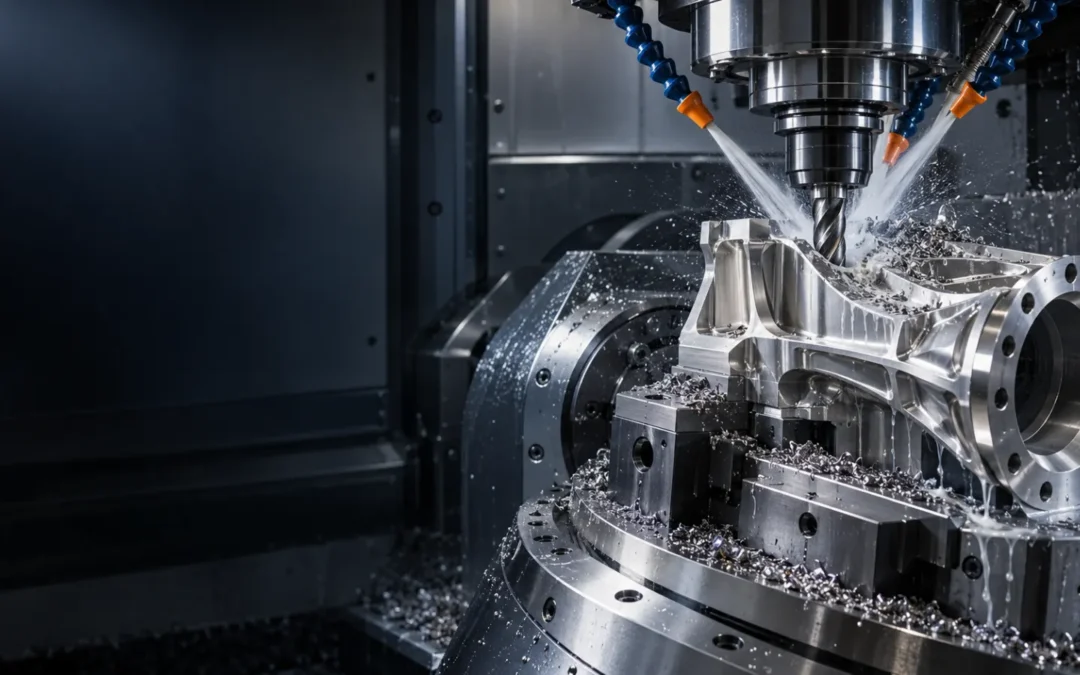
Titanium costs more to machine than aluminum or steel — typically 3–5x more per hour of cutting time, not counting the higher material cost. The reasons are physical, not arbitrary: titanium is a poor thermal conductor, it work-hardens under the tool, it’s chemically reactive at cutting temperatures, and it eats carbide tooling at a rate that makes tool cost a real line item. None of that makes it unmachinable. It makes it expensive if you don’t plan for it.
Quick Summary: Titanium machining costs are driven by slow cutting speeds (60–120 SFM vs 500–1,000+ for aluminum), short tool life (often 15–30 minutes per edge on Ti-6Al-4V), and the need for rigid setups with high-pressure coolant. Cost reduction comes from three places: DFM that minimizes deep pockets and thin walls, tool selection that matches the specific titanium grade, and batch sizing that amortizes setup cost across more parts.
Why Is Titanium Harder to Machine Than Aluminum or Steel?
| Property | Effect on Machining | Cost Impact |
|---|---|---|
| Low thermal conductivity | Heat stays in the cut zone instead of dissipating into the chip — tool runs hotter | Shorter tool life, slower speeds |
| High chemical reactivity | Titanium welds to the tool edge at cutting temperatures (built-up edge) | Galling, poor surface finish, tool failure |
| Work hardening | The surface hardens during cutting if the tool rubs instead of cuts | Must maintain positive feed — dwelling or light passes make it worse |
| High strength-to-weight ratio | Cutting forces are high relative to material density | Requires rigid machine, rigid fixturing, rigid tool |
| Low modulus of elasticity | Part deflects under cutting pressure more than steel would | Thin walls chatter; requires lighter cuts and more passes |
eMachineShop’s guide on material machinability covers how different alloys respond to cutting. For titanium specifically, the machinability rating is roughly 20–30% that of free-machining steel — meaning it takes 3–5x longer to remove the same volume of material.
How Do You Actually Reduce Titanium Machining Cost?
Design for titanium. Avoid deep, narrow pockets that require long-reach tools (more deflection, slower feeds). Avoid thin walls under 0.060” (chatter risk forces very light cuts). Radius all internal corners generously — sharp corners require small-diameter tools at even slower feeds. Every feature that forces the programmer to slow down adds cost.
Buy near-net-shape stock. A part machined from a 4” billet of Ti-6Al-4V that finishes at 1.5” x 1” x 0.75” is wasting 90%+ of the material as chips — at $15–$30/lb for aerospace-grade titanium. Starting with a forging, casting, or plate closer to the finished shape cuts both material cost and machine time.
Use the right tool. Uncoated carbide or AlTiN-coated carbide with positive rake geometry, high-pressure through-spindle coolant (1,000+ PSI), and climb milling. The tool cost per part on titanium is a real number — not a rounding error like it is on aluminum. Budget for it.
Batch your orders. Setup time on titanium jobs is the same as any other job, but the per-piece cutting time is much longer. Amortizing setup across 50 parts instead of 5 makes a meaningful difference in unit cost.
Frequently Asked Questions
Is Ti-6Al-4V the hardest titanium to machine? No — it’s the most common aerospace grade, but commercially pure titanium (Grades 1–4) machines somewhat easier due to lower strength. Beta titanium alloys (Ti-5553, Ti-10-2-3) are harder to machine than Ti-6Al-4V.
Can titanium be machined dry (without coolant)? Not recommended. The low thermal conductivity means heat builds up fast, and without coolant the tool will fail rapidly. High-pressure coolant through the spindle is the standard for titanium aerospace machining.
Does titanium machine better on a 5-axis than a 3-axis? The machine configuration doesn’t change titanium’s machinability — but 5-axis can reduce setups (less re-fixturing of a deflection-prone material) and allow shorter, more rigid tool paths. For complex titanium parts, that’s a meaningful advantage.
Written by James Wright, CEO of Accurate Machine & Tool.
Sources
[1] eMachineShop, “Understanding the Impact of Material Machinability,” emachineshop.com
[2] Modern Machine Shop — titanium machining best practices, mmsonline.com
[3] Machinery’s Handbook, 32nd Edition — titanium cutting data (Industrial Press)