
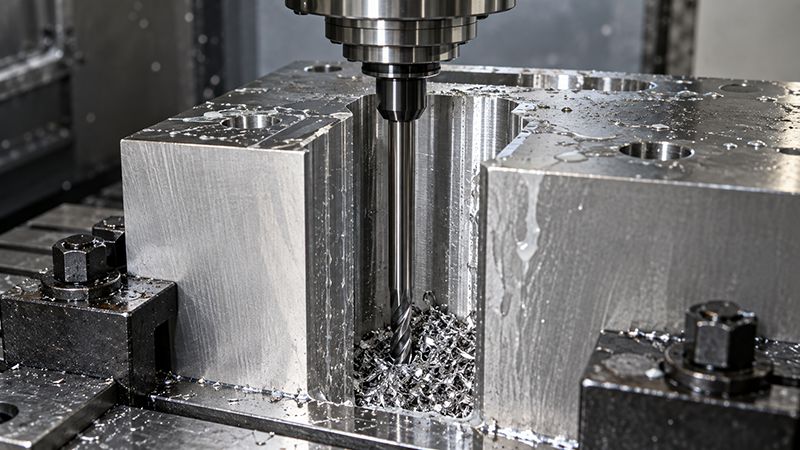
Pocket depth is limited less by the machine and more by the tool — a long, thin end mill deflects and chatters long before most machines run out of Z-axis travel.
Quick summary: Practical pocket depth is generally limited to roughly 3–4x the tool diameter before deflection, chatter, and chip evacuation problems become significant. Deeper pockets require either a larger-diameter tool (which limits how tight internal corners can be) or specialized long-reach tooling at a cost and speed penalty.
What Actually Limits Pocket Depth?
Tool rigidity. A long, thin end mill flexes under cutting load, which degrades surface finish and dimensional accuracy well before the machine’s physical travel limit is reached.
What’s a Reasonable Depth-to-Diameter Guideline?
Roughly 3–4x the tool diameter is a common comfort zone for standard tooling. Beyond that, deflection and chip evacuation become real risks.
What Are the Options for Deeper Pockets?
A larger-diameter tool (which increases the minimum achievable corner radius — see our piece on corner radius cost), a specialized long-reach or reduced-shank tool (slower, more expensive), or splitting the feature into multiple operations.
How Should This Affect Design Decisions?
If a design calls for a deep, narrow pocket, expect either a larger corner radius than initially planned or a cost premium for specialized tooling — there’s no way around the physics.
FAQ
Does material affect maximum practical pocket depth? Yes — harder materials amplify tool deflection risk, tightening the practical depth-to-diameter ratio compared to aluminum.
Can EDM be used instead of CNC for very deep, narrow pockets? Sometimes, yes — EDM avoids the mechanical deflection issue but is a slower, different process with its own cost profile.
Related: How Corner Radius Affects CNC Machining Cost