
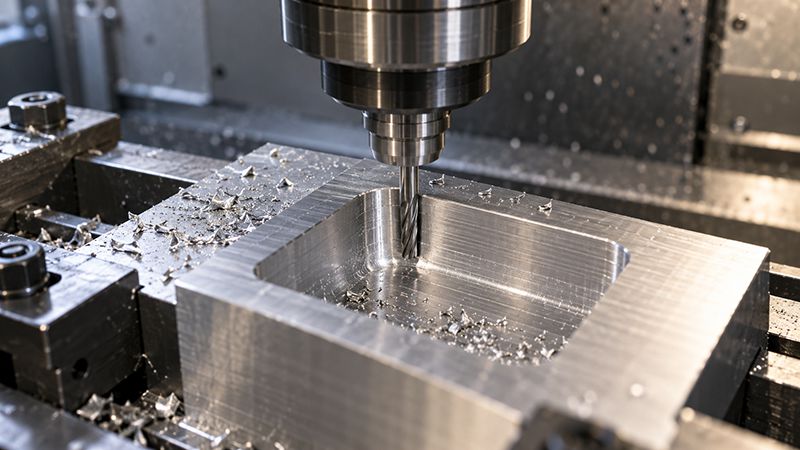
The same physics that makes internal corners impossible to cut square also makes corner radius a direct lever on cost — smaller radius, smaller tool, slower cut, higher price.
Quick summary: Internal corner radius on a CNC part is limited by the diameter of the cutting tool. Specifying a smaller radius than necessary forces the use of a smaller, less rigid tool, which increases cycle time, tool wear, and the risk of tool breakage — all of which add cost.
Why Does a Smaller Corner Radius Require a Smaller Tool?
The tool has to physically fit into the corner. A tighter internal radius requires a smaller-diameter end mill, which cuts slower and deflects more under load.
What’s the Cost Relationship Between Radius and Tool Selection?
Larger, more rigid tools cut faster and last longer. As radius requirements shrink, tool diameter shrinks with it, and cycle time increases — sometimes substantially, especially on deep pockets.
Does Corner Radius Affect Anything Besides Machining Speed?
Yes — smaller tools are more prone to breakage and deflection, which can affect both dimensional accuracy and part reject rate, adding cost beyond just cycle time.
What’s the Practical Guidance for Designers?
Specify the largest corner radius the design will functionally tolerate. Per ASME Y14.5-2018, an explicit radius callout — rather than an implied “as small as possible” — gives the shop room to select an efficient tool.
FAQ
Is there a standard minimum internal radius across the industry? No universal standard — it depends on pocket depth, material, and tool availability; your machinist can advise on the practical minimum for a specific feature.
Does this apply equally to aluminum and harder materials like titanium? The relationship holds directionally in both, but harder materials amplify the cost impact of small-radius tooling due to slower feeds and faster tool wear.
Author: Accurate Machine & Tool Team
Source: ASME Y14.5-2018. Related: eMachineShop’s Why Inside Corners Are Never Truly Square