
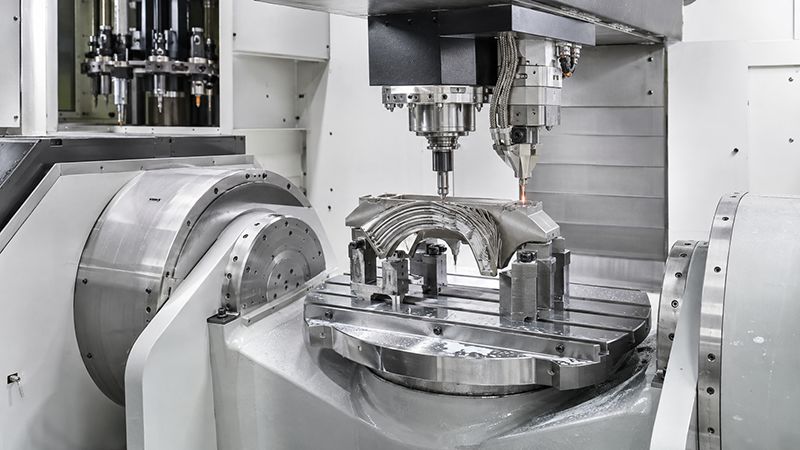
Every machine referenced in hybrid manufacturing research papers is commercially available. Shops are running them right now. The price range runs from under $200K for a retrofit kit on a Haas mill to north of $3 million for a DMG MORI system big enough to build 4-meter parts.
Quick Summary: The market breaks into two tiers. Tier one: purpose-built hybrid machines from DMG MORI, Mazak, and Matsuura that integrate additive deposition and CNC machining in one platform, starting around $500K. Tier two: retrofit kits that bolt a deposition head onto an existing CNC machine — the Phillips/Haas/Meltio package being the most common. This piece covers what each system does, what they cost, and a few things the brochures leave out.
What Are the Purpose-Built Hybrid Machines?
DMG MORI — LASERTEC DED Hybrid Series
DMG MORI has the broadest hybrid lineup. Their LASERTEC DED machines combine powder-fed laser deposition with 5-axis turn-mill machining on a single platform.
The current flagship for mid-size work is the LASERTEC 65 DED hybrid 2nd Generation, launched January 2026. It packs laser deposition welding, 5-axis milling, turning, grinding, laser pre-heating, and 3D scanning into one machine. DMG MORI’s published specs claim a 170% larger workpiece capacity over the first generation, a 35% higher build rate, and 47% lower cost per part. Maximum workpiece is roughly 840mm diameter by 350mm. Both infrared and blue laser sources are available — the blue laser matters for copper deposition, which conventional infrared lasers handle poorly.
For bigger work, the LASERTEC 3000 DED hybrid handles pieces up to 400mm diameter by 1,321mm. And then there’s the LASERTEC 6600 — nearly 4 meters of Z-axis travel, built for energy sector and large aerospace components.
What they cost: DMG MORI won’t publish a number. Industry sources consistently peg the LASERTEC 65 hybrid around $1.5 million. The 6600 is estimated above $3 million. That’s the machine alone — add facility modifications for powder handling, inert gas plumbing, and a filtered ventilation system, and the installed cost climbs further.
Mazak — INTEGREX and HYBRID Multi-Tasking
Mazak took a different path. Instead of building a new machine category, they added additive capability to their existing multi-tasking platform — machines that already combine turning, milling, drilling, and boring in one setup.
The INTEGREX i-400AM was their entry point. It melts metal powder with a fiber laser using cladding heads that store in the standard tool magazine and load through the automatic tool changer, same as any cutting tool. The catch: you choose between a high-speed or high-accuracy cladding head. You can’t have both at once, and swapping between them mid-job isn’t seamless.
Mazak also builds HOT WIRE machines (wire-arc additive with 5-axis capability on the deposition head) and has integrated friction stir welding into the hybrid ecosystem for defect-free joining with minimal heat-affected zones.
What they cost: Mazak’s multi-tasking platforms start in the $500K–$1M range before hybrid capability is added. Hybrid adds to that, but Mazak doesn’t break out the incremental cost publicly. Their real advantage isn’t the technology — it’s the installed base. Mazak builds machines in Florence, Kentucky, has eight Technology Centers across North America, and an enormous number of shops already running their equipment. For those shops, stepping into hybrid doesn’t mean learning a new platform from scratch.
Matsuura — LUMEX Avance Series
Matsuura is the odd one out, and arguably the most interesting. While DMG MORI and Mazak bolt additive deposition onto a milling/turning platform, Matsuura combined powder bed fusion (laser sintering, same family as SLM) with high-speed milling in a single enclosure. It’s the only commercially available machine that does powder-bed printing and milling in the same box.
The LUMEX Avance-25 builds parts up to 256mm x 256mm x 300mm with a 400W or optional 1kW fiber laser and a 45,000 RPM spindle. Matsuura claims 35 cc/h sintering capacity with the 1kW laser and a 75% reduction in milling time through powder suction before the cutter engages. They’ve been selling this machine since 2002 — twenty-four years — and have delivered over 100 units. Almost all of them went into dies and molds shops making injection mold tooling with conformal cooling channels.
What they cost: Not published. Estimated $500K–$800K for the Avance-25. The Avance-60 (600mm x 600mm x 500mm build volume) is more.
How Do They Compare Side by Side?
| DMG MORI LASERTEC 65 DED hybrid 2nd Gen | Mazak INTEGREX i-400AM | Matsuura LUMEX Avance-25 | Phillips/Haas/Meltio Additive Hybrid | |
|---|---|---|---|---|
| Additive process | Powder DED (laser) | Powder DED (laser) | Powder bed fusion (SLM/SLS) | Wire DED (laser) |
| Subtractive process | 5-axis turn-mill + grinding | Multi-tasking (turn/mill/drill/bore) | High-speed milling (45K RPM) | 3- to 5-axis milling (Haas platform) |
| Max build envelope | ~840mm dia x 350mm | ~400mm dia (workpiece dependent) | 256 x 256 x 300mm | Dependent on Haas model selected |
| Estimated price | ~$1.5M | $500K–$1M+ (hybrid config) | $500K–$800K est. | Under $200K (full package) |
| Primary application | Aerospace, repair, large parts | Repair, remanufacturing, multi-process | Injection mold tooling, conformal cooling | Entry-level hybrid, shops with existing Haas |
| Installed base | Strong globally, growing in U.S. | Very large U.S. installed base | 100+ units, mostly dies/molds | Leverages 30K+ Haas machines in field |
What About Retrofit Kits?
Phillips Corporation / Haas / Meltio — Phillips Additive Hybrid
Phillips Corporation (Hanover, MD) bolted Meltio’s wire-based DED laser head into Haas CNC platforms — VF vertical mills, UMC 5-axis machines, TM toolroom mills. The deposition head stores in the tool magazine alongside conventional cutters.
This is the lowest-capital entry point into hybrid manufacturing for any shop with a Haas machine. Phillips has since expanded to include Fronius wire-arc and Laserline laser-powder deposition heads, so three different additive technologies now run on the same Haas base.
What it costs: A base Haas VF-4 lists around $70K–$90K. The Meltio integration adds to that, but the full package is estimated well under $200K — roughly a tenth of a DMG MORI LASERTEC. The trade-off is real: Haas machines are less rigid than DMG MORI or Mazak platforms, the deposition quality ceiling is lower, and the control system is simpler. For prototyping, repair work, and non-critical deposition, that may not matter. For aerospace production parts with tight tolerance requirements on the deposited features, it probably does.
Phillips Federal sells the same platform to U.S. government buyers.
What Do the Brochures Leave Out?
Operators are hard to find. Running a hybrid machine means understanding CNC programming, metallurgy, additive process parameters (powder flow, laser power, scan strategy), and how to sequence additive and subtractive operations without one wrecking what the other just did. That person doesn’t come out of a standard machinist training program or a standard additive technician program. They come out of both, plus experience. We’ve talked to shops running these machines who say the operator learning curve, not the machine itself, is the real bottleneck.
Powder handling adds cost beyond the machine. Laser powder DED systems need inert gas, powder storage, sieving, recycling, and safety protocols that a conventional chip-making shop doesn’t have. Wire-based systems (Meltio, Mazak HOT WIRE) dodge the powder issue but trade off resolution and surface finish.
Utilization math can work against you. A $1.5M hybrid machine that spends 40% of its cycle depositing material and 60% machining is doing two jobs at the pace of neither. Some shops find that a dedicated SLM printer plus a dedicated 5-axis mill — each running at full capacity — outperform a hybrid machine that compromises on both. The hybrid’s edge is alignment precision (no re-registration error between machines) and flexibility on small lots, not raw throughput.
Maintenance is three jobs in one. Optical systems, powder/wire feed mechanisms, and conventional cutting tool systems share an enclosure. When the laser nozzle needs service, the mill is down too.
Where Does This Leave Shops That Don’t Own Hybrid Equipment?
Most hybrid manufacturing in practice doesn’t happen on a single hybrid machine. It happens as a two-step workflow: a printed blank from an additive fabricator, CNC finishing in your own shop. That doesn’t require a seven-figure capital purchase. It requires knowing how to specify the machining allowance on a printed blank (covered in our tolerance recipe blog), CNC equipment capable of finishing printed parts, and QC capability to inspect and document the results.
Both eMachineShop and Accurate Machine & Tool work with SLM fabricators and finish parts in-house. If you’re evaluating whether to build, buy, or outsource hybrid capability for your production needs, reach out — we can help you figure out the right split between additive sourcing and CNC finishing for your specific parts and volumes.
Written by James Wright, CEO of eMachineShop and Accurate Machine & Tool, Inc.
Sources
[1] DMG MORI — LASERTEC DED Hybrid series, us.dmgmori.com
[2] Mazak — HYBRID Multi-Tasking, mazakusa.com
[3] Matsuura — LUMEX Avance series, matsuurausa.com and lumex-matsuura.com
[4] Phillips Corporation — Phillips Additive Hybrid, phillipscorp.com
[5] American Machinist, “Hybrid Machining Is Growing,” 2026